Quick answer
Seychelles offers shore-accessible snorkeling in sheltered bays with granite boulders, sea turtles, and seasonal visibility that peaks during the calmer months of April through May and October through November. The Maldives provides year-round clarity, house reefs within resort reach, and richer soft coral formations, though prime sites often require boat transfers. Seychelles suits independent travelers exploring marine parks like Sainte Anne; the Maldives favors resort-based itineraries with daily reef access.
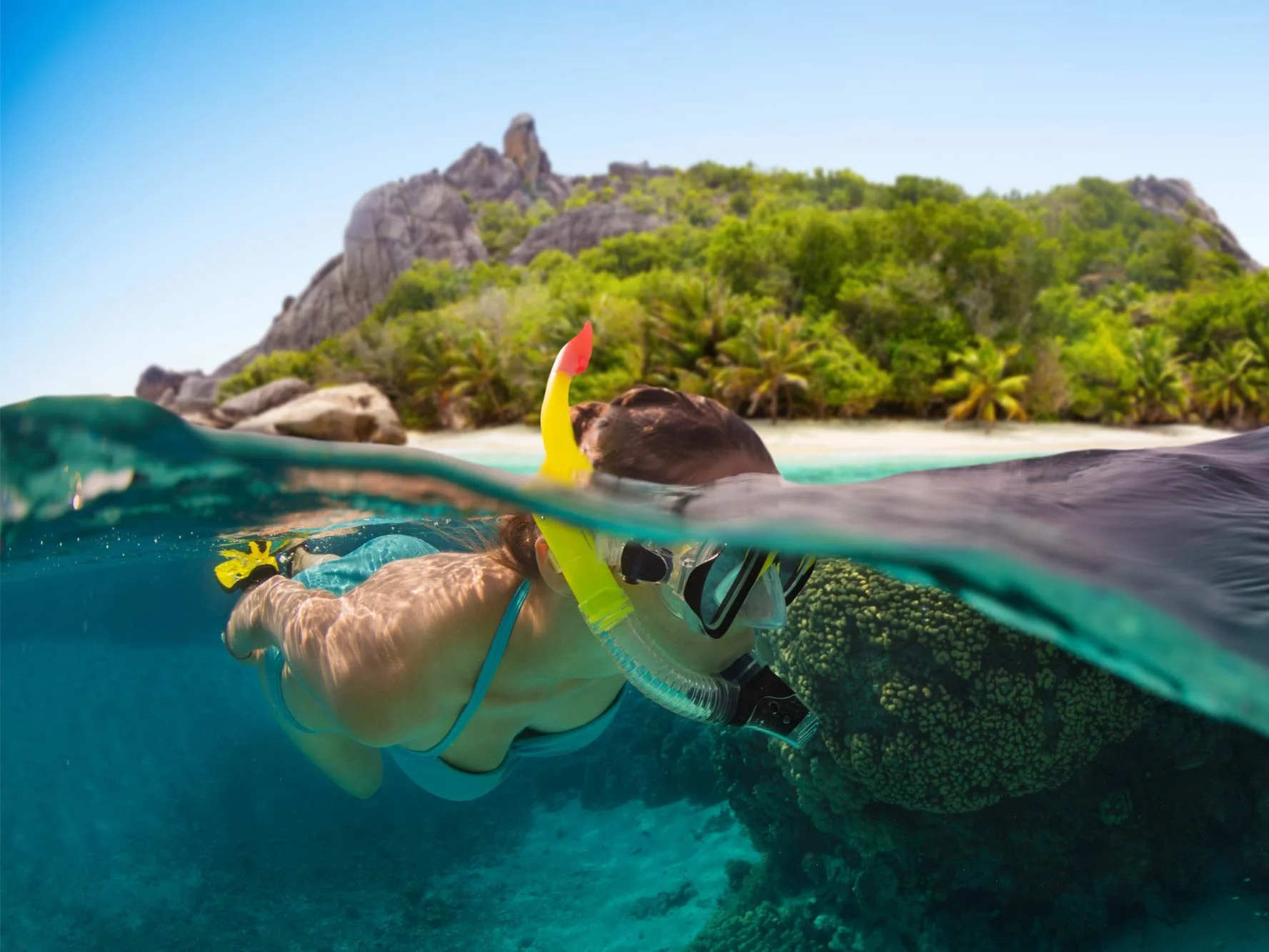
Granite formations distinguish Seychelles reefs from the purely coral atolls of the Maldives. At Sainte Anne Marine National Park, boulders create swim-throughs and shaded overhangs where hawksbill turtles forage on sponges, and the topography remains legible even when visibility drops to twelve meters during the southeast trades. The Maldives relies on open-water clarity—often exceeding thirty meters—to showcase its soft coral walls and pelagic visitors, but that advantage depends on calm conditions and distance from channels stirred by tidal exchange. Marine biodiversity follows different patterns. Seychelles harbors endemic species like the Seychelles anemonefish and a higher density of octopus and moray eels within its boulder fields. The Maldives counters with manta cleaning stations, resident reef sharks, and schools of fusiliers that dwarf anything in the granitic islands. Neither destination lacks color or activity, but the Maldives rewards patient observation of larger fauna, while Seychelles invites exploration of complex micro-habitats formed where rock meets coral. Access logistics tilt the comparison toward different travel styles. In Seychelles, you wade from public beaches into protected zones—Sainte Anne charges a conservation fee and operates with fixed park boundaries. The Maldives embeds snorkeling within resort infrastructure: house reefs are steps from overwater bungalows, but venturing beyond the resort channel usually means booking a dhoni transfer. Independent snorkelers favor Seychelles for its lack of gated access; resort-focused travelers prefer the Maldives for turnkey convenience and the guarantee of a healthy reef outside the villa. Current and surge also separate the two. Seychelles experiences stronger directional currents during monsoon transitions, making some sites unsuitable for weaker swimmers between May and September. The Maldives moderates current exposure through atoll geography—inner reefs stay calm while outer channels run fast—but that segmentation often places the most dramatic topography beyond unguided reach. Comparing snorkeling in Seychelles and the Maldives ultimately means choosing between geological variety and coral abundance, between park-based exploration and resort-curated access.
“Granite formations create swim-throughs and shaded overhangs where hawksbill turtles forage, and the topography remains legible even when visibility drops during the southeast trades.”
Snorkeling Seychelles vs Maldives: How Do They Differ?
Choosing between snorkeling in the Seychelles and the Maldives depends on whether you prefer the unique granite-based underwater topography of the Seychelles or the extensive coral atoll systems of the Maldives.
|
Top pick Seychelles Granite-based marine environment |
Maldives Coral atoll systems | |
|---|---|---|
| Reef Structure | Granite boulders and coral patches | Extensive shallow coral atolls |
| Marine Life Diversity | Pelagic species and reef fish | High-density reef fish and shark species |
| Beach Entry Access | Accessible via granite-fringed coves | Common on most resort islands |
| Depth of Water | Varied with immediate drop-offs | Predominantly shallow lagoons |
| Marine Conservation Status | Protected via National Marine Parks | Regulated via resort-led management |
Verdict: Choose the Seychelles for diverse granite formations and deep-water coastal exploration, or the Maldives for classic, shallow coral atoll snorkeling.
Best Time for Snorkeling Seychelles vs Maldives
The prime window for snorkeling in the Seychelles occurs during the transition months of April, May, October, and November when trade winds are weakest. These periods offer the clearest water and calmest sea conditions, contrasting with the more consistent but wind-affected monsoon seasons of the Maldives.
April–May
ModerateCalm seas, 28°C to 30°C
Water clarity is at its peak as trade winds shift. This is the optimal time for visibility.
June–September
HighStronger Southeast trade winds, 25°C to 27°C
Surface conditions may become choppy due to seasonal winds. Snorkeling is best on protected leeward sides.
October–November
ModerateCalm, warm, 28°C to 30°C
Similar to the spring, these transition months provide ideal, still conditions. Underwater visibility improves significantly.
Weekday mornings
Low—
The best arrival window is 08:00–11:00 to ensure calm sea conditions and clarity before afternoon winds arise.
Verdict: For the highest probability of calm, clear water, target the transition months of April or October and arrive between 08:00–11:00.
Daily Operational Hours for Snorkeling Seychelles vs Maldives
The Sainte Anne Marine National Park is open daily for visitors. We recommend arriving between 08:00 and 11:00 for optimal water clarity and calmer sea conditions.
| Monday | 08:00–17:00 | |
|---|---|---|
| Tuesday | 08:00–17:00 | |
| Wednesday | 08:00–17:00 | |
| Thursday | 08:00–17:00 | |
| Friday | 08:00–17:00 | |
| Saturday | 08:00–17:00 | |
| Sunday | 08:00–17:00 |
Logistics for Snorkeling Seychelles vs Maldives
Sainte Anne Marine National Park is located off the coast of Mahé, Seychelles. Access to these snorkeling sites is primarily via boat charters departing from Victoria or nearby jetties on Mahé.
Charter from Victoria/Eden Island Marina
Travel to Victoria or Eden Island
Drive to Victoria/Eden Island parking
Check availability
Frequently asked questions about snorkeling seychelles vs maldives
Everything you need to know about snorkeling seychelles vs maldives